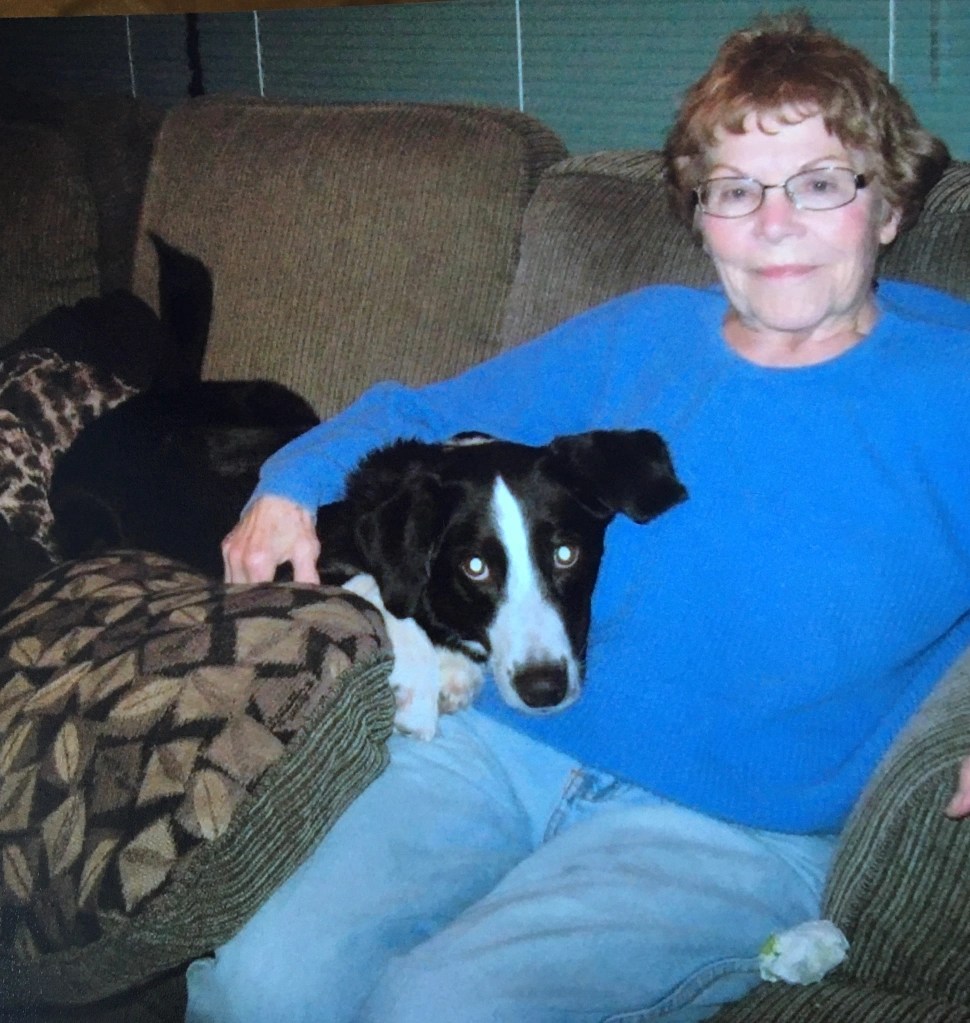
In January 2019, our household came down with a virus of some sort that has been seen making it’s way through the Ottawa area. I am concerned for mom. Illness of any kind – colds, flu viruses, will often intensify dementia, at any stage. It also kicks up what is called Sundown Syndrome, a condition that affects people in mid to late dementia stages and also people with Alzheimer’s. Those with dementia can become hyperactive, agitated and confused, with symptoms extending into the night, causing sleep disruption.
We all take turns getting it. Runny nose, cough, laryngitis, and generally feeling lousy. We all recover in about a weeks time, but mom can’t seem to shake the laryngitis. One day she sounds like a cartoon character, one day Marge Simpson, another day, no voice at all.
I schedule an appointment for mom with her doctor to take a look at her to make sure it’s not something that requires antibiotics. Her doctor listens to her lungs and says they are clear. She adds that, “as laryngitis has been a known part of the virus going around, it’s just taking it’s time to leave.”
A few days later, the symptoms of congestive heart disease kick up again with her lungs filling up with fluid. We make our way to the emergency department, where they take her in immediately and to drain her lungs. While this is going on the attending doctor who happens to be an ENT, Ear, Nose and Throat specialist asks me how long the laryngitis has been hanging around. I give him the low down what has happened so far and he tells me he’d like to run a few tests. The tests show that her voice box is inflamed and his concern is that it may become difficult for her to breathe and would like to admit her to critical care to keep an eye on her and to figure out what is going on. I am speechless.
My poor mom, she is quite upset, discouraged and confused as to why all of this is happening to her. In her mind, she has done everything right, exercise, self care, eating right. She said the same thing to the cardiologist after her heart attack, to which he says, “Anne, many of my patients are athletic types and have done, in the their minds, everything right, these things just happen.”
Eventually, we make our way to critical care they put her on prednisone, which seems to help the inflamation. What a place, floating beds, high tech everything and the doctors and nurses are absolutely wonderful. They will keep her here until they are certain she is stable and then move her out of critical care and on to a floor for observation.
All of this is happening so fast, I have hardly enough to think, let alone rest and rejuvenate. And mom, well, given the early onset dementia and the unfamiliar surroundings, her head is spinning. She is very confused and calm at the same time.
On this day, her doctor asks me for a meeting in one of the private rooms. He feels that perhaps we are looking a cancer in the throat and seems pretty certain of that. I am devasted. The doctor would like to move her to an observation ward for Ear, Nose and Throat issues at The Ottawa Hospital and this will happen tomorrow.
I return to her room to speak with her about what he has said. She seems totally unfazed and asks when lunch is coming and is also concerned about the shape of the room, the walls are rounded not square and she is having issue with that.
The next day mom is moved by ambulance to the hospital in the am with a paramedic that specializes in throat issues. The obervation ward is perfect for her. There are about a dozen beds around the outside of the room facing inwards with the nursing station in the center of the room where both patients can see staff and staff can monitor patients. And, there is always someone around which is a comfort for her when she is on her own.
Her first nurse is Jason and he is just lovely, so kind. After he does her vitals and he leaves, my mother says to me, “I know I’m 88, but if I was younger, I wouldn’t be letting him out of my sight. He’s so handsome.” Too funny.
They have scheduled a biopsy in two days time so food will stop in the am prior to surgery the following day. This becomes challenging as often these types are surgeries scheduled for patients in hospital are bumped due to more critical situations that arise. Understandable, but tell that to a hungry lady with early onset dementia. Needless to say we had our work cut out for us keeping her occupied. We never make it into surgery that day, so by 5 pm, we find dinner for her, but then cut her off a 9 pm hoping for a slot in surgery the following day. So round 2 begins.
The next day, the same thing happens. I guess third times a charm and around 3 pm the third day, a nurse shows up without warning and said, “you’re going now”. Mom was ok with this, because she probably didn’t really understand what was going on. Unfortunately, because I’d been so worried and exhausted, my anxiety kicked in, leaving me feeling lightheaded, which landed me in a wheelchair, following mom on a gerny, to pre op. When we arrived the nurse says,”what’s up with you?” I said “don’t ask, I’m tired, lightheaded, probably hungry and worried about my mom.” She said, “no worries, it happens alot. Nothing a glass of wine, possibly a joint and a good night sleep can’t fix.” Meanwhile, mom is in her glory, as she is currently surrounded by 4 handsome young male nurses speaking to her before they take her in to surgery.
The biopsy shows nothing and they decide to do a second one the following week from another direction hoping that this will yield them some answers. It does not.
The doctors are really struggling to understand and name what this is, so they can treat my mom. The doctor tells me that they have never seen anything like this before, anywhere, ever. The voice box is cartilige and it is swelling, inflamed and crumbling. They suggest a tracheostomy and give me literature to read. Honestly, I am spent at this point, tired, upset and being the primary care giver and decision maker, it’s just plain hard. This day I go to my car in the parking garage to just chill for a bit and fall asleep in the back seat for a couple of hours and wake up not knowing where I am. Surprised, not. It was a who, what, where moment.
A trachiostomy is a big deal for anyone, particularly an 88 year old lady with early onset dementia. They must be maintained and there are no guarantees they will even work. And then theres the issue of quality of life, which would definitely degrade too. A few days later her doctor comes by to speak with both of us.
Let me just say, my moms throat specialist was awesome, brilliant, kind, thoughtful and a straight shooter. She says to my mom, “Anne, I really don’t think a tracheostomy is the right thing for you, mostly because your quality of life would go straight out the window. You could have it, but perhaps you might choose that this be your time to go.” I was both shocked and grateful for her honesty. Truth is, they did not know what was going on in my moms throat. All they knew was at its current trajectory, she would probably, eventually suffocate.
I looked hard within and consulted with my mom. She said, “she didn’t want to die, but she didn’t want to live like this.” So we went with quality of life and a few days later they moved her to a room with an awesome roommate and a view.
While her medical team continued to try to figure out what was going on, our family team stepped up to the plate and worked to brighten each day for her. Early on I had hired a friend to help with my mom, a companion type arrangement that allowed me the occaisonal rest times that were desperately needed. For any of you going through the illness of a family member, I cannot stress enough the importance of self care. You simply cannot give to others if you short change yourself. And, even if you do have help, you will still be tired, but not as tired as you would be with no support of any kind.
We would bring lunch, go for a wheel outside, bring the paper, a coffee, wheel downstairs toTimmy’s or some frozen yogurt. Mom was constantly says how much she loved the nurses colourful running shoes, so I went out and bought 6 pairs for her to try on. The nurse thought we were crazy, to which I said, “I had to bring the shoes to the lady!”
Over the next few weeks, the nurses from the other unit came by to say hi to my mom and have a little visit and she continued to walk the ward several times a day with her walker. My daughters would visit and climb into bed with her and my son and her would critique Vogue Magazine fashion looks cover to cover. We even brought the dog in for a visit. We also got to know many of the other patients and their families during this time, which I highly recommend as it brought comfort to all of us during this difficult time. A lady a few rooms down from my moms was a avid runner with her husband and since she had been ill was unable to participate in an annual run here in Ottawa. In lieu of that, the organizers allowed her to participate virtually, her husband participated and carried a tablet over the finish line while she was connected in. The organization awarded her a ribbon, which he brought in to show my mom. You know, you see the best in yourself and that of people when life forces you to become present to a situation.
Eventually, a palliative team was added to my moms care. These people are a different breed of extraordinary. Not only for those who are dying, but those patients who are critically and/or chronically ill. They feel that mom is stable enough to go home and they teach us what she will need to help us prepare. We will learn how to give injections, medications and care for my mom at home, myself, my daughter and my moms caregiver. Monday is the day, it is Friday. We have 3 days to learn and get ready. We have a family meeting with the palliative team prior to her departure. The doctor says, “Anne you’ve been dealt a shitty hand of cards here.” “How do you like to spend your time, he asks.” “With my family, she replys.” He says, “well, I want to go home and do that, do what makes you happy.” I thank him and his team and ask him if I can give him a hug, he says, “I’m from Brazil, I love a good hug. Bring it.”
Monday arrives and we are packed and ready. I am driving her home and the rest of the family is waiting at the other end to help get her in. We make our way down Main Street as the 417 is busy as it is rush hour. I remember everything being so vivid in colour and in the sounds of the city. She is content and happy to be coming home and strangely surreal. In hindsight, I felt a strange glow around her and within the car that felt like pure light and love.
We arrive home and get mom into the house to settle. It’s been a long day for all of us. At around dinner time a car pulls into the driveway. I answer the door to find a young man, tatooed, in fatigue style clothing and a backpack. He introduces himself as my moms palliative nurse.He apologizes for arriving so late, but had been making his rounds with other patients and had been delayed. I invite him in and introduce him to my mom to which she says, “I don’t want you, I want a lady!” I say, “give him a chance mom.”
He would like to review the medication regime and asks if we could move into a quieter space. For the next hour and a half, he pre-loads all of the syringes and reviews the routine. Apparently, he and his wife are both nurses, but he does palliative care with mostly kids. We speak of any things, how the kids love his look, his Buzz Lightyear t-shirt, his tattoos and piercings. His says the hardest part of his job is when one of his young patients passes away and he often has to immediately go to another appointment with another of his young patients. He is so patient, so kind and a good teacher. I understand what I need to do and we finish up. I realize later that evening that he wasn’t there for my mom, but he was there for me. Helping me with the reality that my mom was dying, that she was coming home to die.
That night mom is extremely restless and I spend most of the night curled up at the bottom of her single bed trying to comfort her. I realize that we need a hospital bed so that she can sit up a bit more during her sleep as it helps her breathing. I plan to order one the following day and arrange to move a chase lounge chair in basement upstairs in the same room so that one of us can sleep on it and be in the same room with her. Her caregiver has stayed with us since she arrived home to give us some respite and tonight she suggests I go get some sleep and she will sit with my mom. I comply.
About 2:30 am, she wakes me up to come as she feels that she is slipping away. The kids have been called and will arrive shortly. The palliative team has also been contacted. Mom asks if the ambulance has been called. I don’t answer because we had decided we would not call them. In her panic, she says, “if you won’t call, maybe Deborah will.” She is my helper for my mom. In this situation, if you do and they move her to hospital and something happens on the way, your wishes go out the window and they will resuscitate, using all means necessary including using alot of force on her rib cage. With her so fragile, this would not be a good thing, resulting in broken ribs. In all of the emotion, we end up calling an ambulance anyway and within about 20 minutes they arrive. They tell me that this is an end of life situation and that they will wait outside. At the same time the palliative nurse arrives.
Within a few moments, mom is unconscious and breathing heavily. Realizing this reality, we turn on some music, Louis Armstrong and sit with her, all of us, including Ellie, my moms granddog. As I hold her hand, she goes.
*
After about an hour or so, the funeral home people arrive to take my mom. My son Derek says, “she can’t go without her lipstick,: and he touches it up.
My mom is taken to the funeral home for cremation and the day that is to be done one of my moms doctors calls to give her condolences. She was next to see my mom in her healthcare team, a Rheumatologist. As I am speaking to her, I ask if she thinks an autopsy should be done, at least on her throat. Given that they were never able to determine what was wrong and name it, she agrees that it might be a good idea. She says that normally that do not bring someone back to hospital after releasing them to the funeral home, but in this case, she feels compelled to arrange it.
About a week later the doctor calls me to let me know the results. They found nothing they could identify or name.
Mom is gone.
 Bev Hille, The Practical Empath